
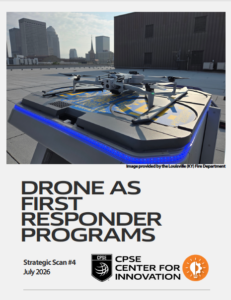
 The Center for Public Safety Excellence® (CPSE®) Center for Innovation (CPSE CFI) has released our fourth Strategic Scan, Drone as First Responder (DFR) Programs, which can be viewed here. For this report, DFR programs are defined as operations in which a drone is first to arrive on scene and provide live video footage. These programs are not designed to replace first responders or their expertise.
Data were gathered in May and June 2026 and the Strategic Scan details how many accredited agencies currently operate or collaborate on a DFR program, the most common response types for drone deployment, and how those programs are piloted. The report also describes the most common response modifications based on drone footage, such as adding, reducing, or repositioning resources, as well as upgrading or downgrading alarm levels.
Due to the recent emergence of DFR programs, the survey used to create this Strategic Scan report was shorter than previous surveys. Rather than actionable takeaways, CPSE CFI is developing an implementation guide for effective and ethical DFR programs in partnership with our Industry Advisory Council members. Using the survey results, we selected seven geographically diverse departments to create a task force. Representatives from those departments who have expertise in their agencies’ DFR programs are participating in three one-hour virtual discussions to share more about the operationalization of their programs.
“We’re excited about this fourth strategic scan on DFR programs because we’re using a mixed methods approach,” said CPSE CFI Board Vice President Alexander Henderson, Ph.D., CTO, Associate Professor, Marist University. “This allows us to get the breadth of information from a larger number of survey respondents and then build our qualitative data collection efforts with our task force in a more targeted manner. The depth of information that this group has provided will allow us to build that a substantive implementation guide for departments considering a DFR program.” A special thank you to Marist University, where Dr. Henderson is an Associate Professor.
“Participating in the Drone as First Responder Task Force has been a valuable opportunity for our department—not just to advance our own capabilities, but to learn alongside our peer agencies across the country,” said CPSE Board President Derek Bergsten, CFO, CEMSO, CTO, PIO, Fire Chief of the Poudre Fire Authority. “Hearing how other departments approached the same challenges we faced, from airspace coordination to real-time video integration with dispatch, gave us insights we couldn’t have developed in isolation. This kind of shared learning is what makes public safety innovation move faster and smarter. We’re grateful to have been part of a cohort that was so willing to share what worked, what didn’t, and what they’d do differently. That candor made all of us better prepared to bring this technology safely into our communities.”
The Strategic Scans are part of our Actionable Research program. For this report, we surveyed fire chiefs of departments accredited by the Commission on Fire Accreditation International.
Download the CPSE CFI Strategic Scan on Drone as First Responder Programs here.
About CPSE CFI
The CPSE Center for Innovation serves as a catalyst for innovation in the fire and emergency service. A wholly owned 501 (c)(3) nonprofit subsidiary of CPSE, CPSE CFI highlights innovative solutions developed by CPSE-accredited agencies and credentialed professionals and addresses an industry-wide gap in evidence-based decision making. Learn more at https://www.innovationcpse.org